

AI Simplified – Stop Confusing AI, Machine Learning & Deep Learning!
Introduction: Why Everyone’s Confused
Table of Contents show
1 Introduction: Why Everyone’s Confused
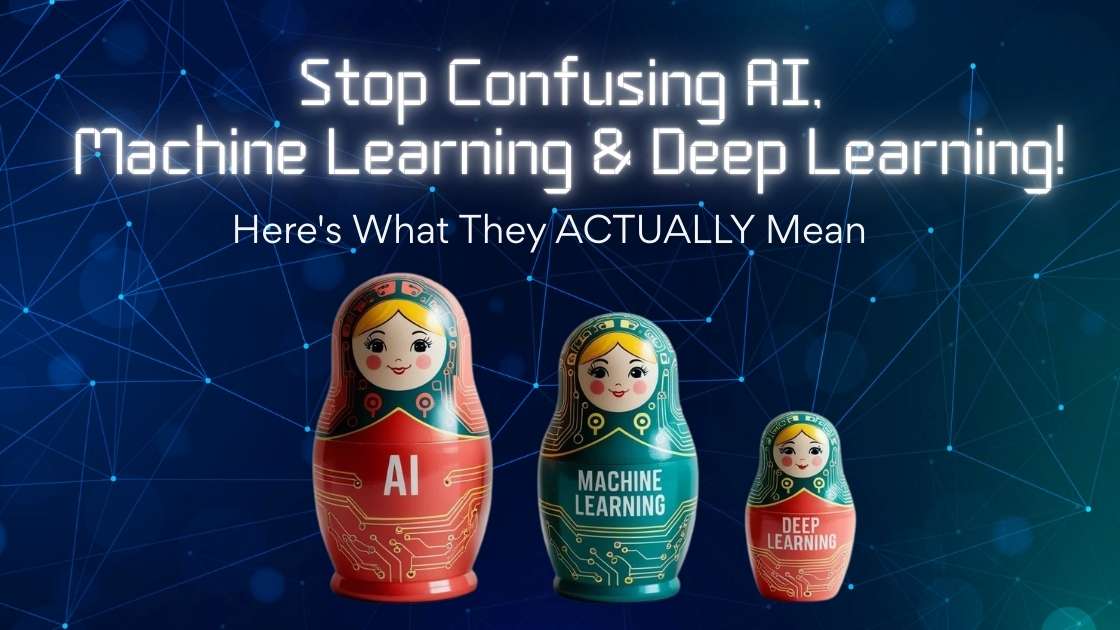
2 The Russian Nesting Dolls Analogy: How It All Fits Together
2.1 Doll #1: Artificial Intelligence (AI)
3 Doll #2: Machine Learning (ML)
5 Real-World Examples: The Receipts
6 The Comparison: What Makes Them Different
7 Why This Matters (and Why You Should Care)
Need a refresher on what artificial intelligence actually is before diving into these distinctions? If you’ve ever used the words AI, machine learning, and deep learning like they’re the same thing, you’re not alone.
And you’re also… kinda wrong. But don’t worry, we’re going to fix that.
When I first started learning about AI, it felt like I was watching a group chat full of engineers argue in code. One person’s like, “AI is the future!” The next person says, “That’s not AI, that’s machine learning.” And some guy in the back is yelling, “It’s deep learning! Get it right!”
Meanwhile, I’m just trying to figure out if ChatGPT counts or if I need to start downloading quantum data sets. Sound familiar? Let’s clear this up once and for all.
The Russian Nesting Dolls Analogy: How It All Fits Together
Doll #1: Artificial Intelligence (AI)
The big umbrella. AI = Any computer system that can do something “smart” that usually requires human thinking. Like recognizing your voice. Or beating you at chess. Or recommending you a playlist.
Doll #2: Machine Learning (ML)
A smaller doll inside AI. ML is when the system learns from data to make decisions or predictions—without being explicitly programmed. Example? Netflix noticing you binge-watch romance movies and serving up 3 more romcoms before you even blink.
Doll #3: Deep Learning (DL)
The smallest but most powerful doll. Deep learning is a type of machine learning that uses neural networks—inspired by the human brain—to process data in very complex ways. Think: speech recognition, self-driving cars, ChatGPT, image generation.

So yes—all deep learning is machine learning, and all machine learning is AI… …but not all AI is deep learning. Clear as Canva now? 😌
Real-World Examples: The Receipts
Let’s break it down with receipts and go a little deeper on each:
AI Example (Rule-Based)
Remember the old Microsoft Clippy? That’s traditional AI—it follows specific rules programmed by humans. “If user types ‘Dear,’ then offer to help write a letter.” No learning involved.
Machine Learning Example
Spotify doesn’t just recommend music based on what you’ve listened to—it analyzes patterns across millions of listeners to predict what you might like next. It improves its recommendations as you interact with it.
Deep Learning Example
ChatGPT doesn’t just match patterns—it processes language in layers, understanding context, tone, and even generating creative content. It can write a poem about AI in Shakespearean style because it’s learned from massive datasets how language works at a deeper level.
The key difference? Traditional AI follows rules. Machine learning finds patterns. Deep learning understands complexity.

The Comparison: What Makes Them Different
Let me break down the key differences:
Data Requirements
Basic AI: Can work with rules, no data needed
Machine Learning: Needs structured data
Deep Learning: Thrives on massive amounts of data
When To Use Each
Basic AI: Simple, rule-based decisions
Machine Learning: When you have clear data but complex patterns
Deep Learning: For very complex tasks like understanding language or images
Real Talk: Companies will often slap “AI” on anything for marketing. Now you know enough to call their bluff. Visual learners might benefit from creating a mind map in a dedicated notebook to see how these concepts connect.
Why This Matters (and Why You Should Care)
Understanding this stuff isn’t about being “techy”—it’s about being prepared.
Whether you’re:
Exploring a career in tech
Running a business
Or just trying not to fall behind in a world moving at ChatGPT speed
This knowledge gives you power. Power to use the right tools. To make smarter decisions. To understand the headlines (instead of skipping them).
“You don’t need to be a developer to understand AI—you just need the right explainer.”

The Bottom Line
Now that you understand the difference between AI, machine learning, and deep learning, you can:
Make better decisions about which technologies might help you
Cut through marketing hype about “AI-powered” products
Have intelligent conversations about these technologies (without nodding along while screaming internally)
These concepts make great teaching moments! Check out these colorful gifts that make explaining tech concepts more engaging.
What technology do you think will impact your life the most in the next 5 years? Is it rule-based AI, machine learning, or deep learning? Let me know in the comments!
Next up in the AI Simplified series: The 5 Types of AI Tools You’ll Actually Use (And Why They Matter)
Check out the rest of the articles in the series – AI Simplified – The Complete to Understanding Artificial Intelligence – without the jargon.